Artex Ceiling: Your Options for Removal, Skimming or Covering
Three honest options for dealing with an Artex ceiling. Costs, disruption, and which choice fits your property. From a York plastering team with 15+ years of experience.
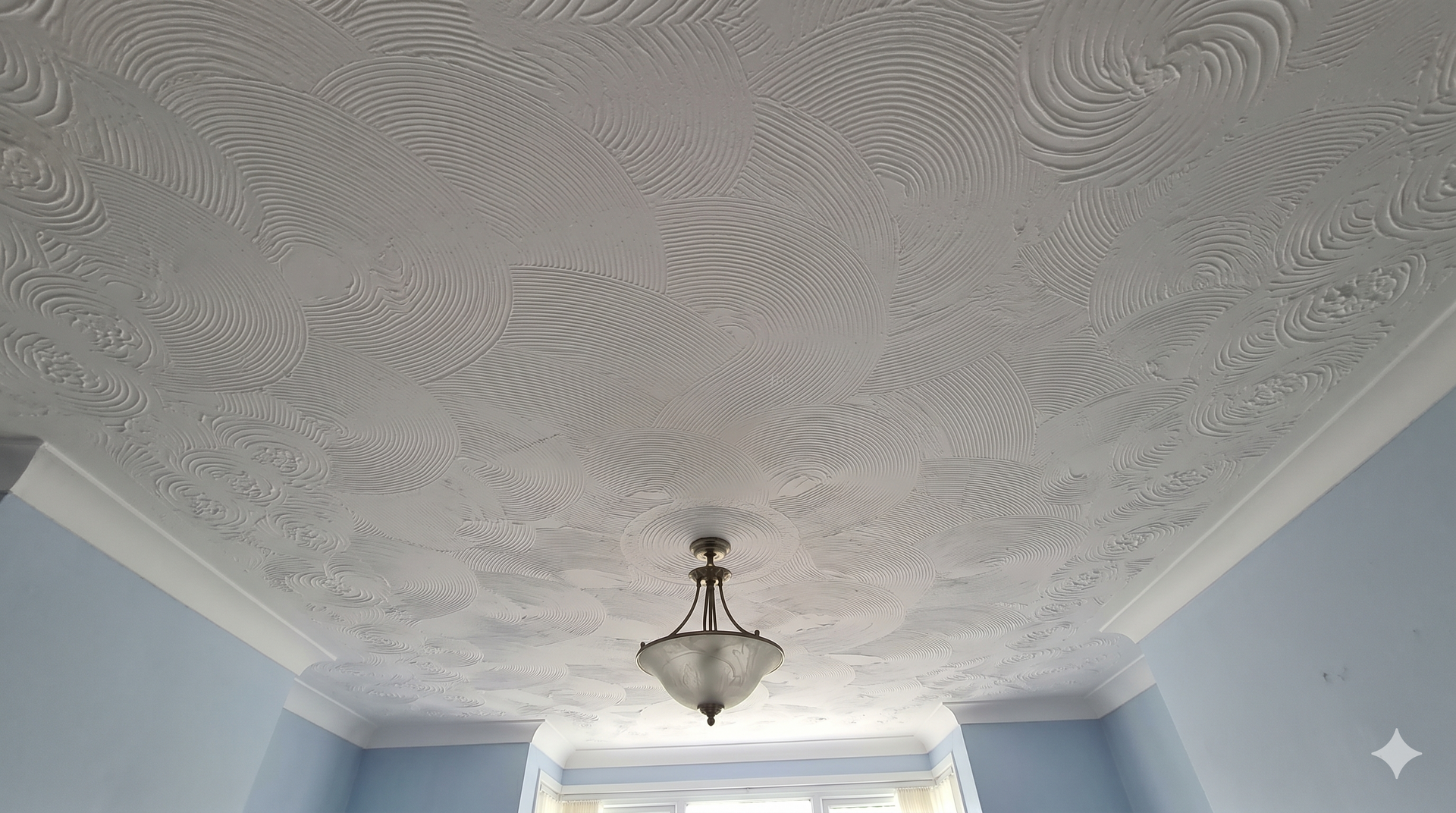
Walk into any pre-1990s house in York and there's a fair chance you'll look up and see it. The swirls. The fans. The thick stippled texture that someone in 1978 thought looked smart. Artex.
Most of our customers don't want to keep it. The real question is what to do instead, and that turns out to be three separate options rather than one obvious choice. Each suits a different property, a different budget, and a different tolerance for mess.
First, the asbestos question
This matters. Textured coatings applied before 2000 may contain asbestos. Do not sand, scrape, drill or steam a suspect coating until a representative sample has been assessed by a competent asbestos surveyor or UKAS-accredited laboratory. Material that is intact and left undisturbed is generally lower risk than material being damaged during preparation or removal.
If the coating may pre-date 2000, arrange representative sampling before deciding on a method. A positive result does not automatically mean every job requires a licensed contractor: the material, condition, method and risk determine whether work is non-licensed, notifiable non-licensed or licensed. Higher-risk work, or other asbestos-containing materials in the ceiling build-up, may require a licensed contractor. A competent asbestos professional should advise on the route.
Either way: don't put a sander on it until you know.
Option one: Skim over
A plasterer keys the existing surface, applies a bonding agent, and skims a fresh layer of finishing plaster over the top. The Artex stays where it is. You end up with a flat, paintable ceiling.
Pros: it's the cheapest of the three. Quick too. Most ceilings get done in a day, with no removal mess. If the original Artex is a mild stipple or a fine fan pattern, the result is clean.
Cons: it doesn't work on every Artex profile. Deep swirls or chunky textures can bleed through a single skim coat and you'll still see the pattern faintly. You're also adding weight, so older lath-and-plaster ceilings need checking first. Soundness of the existing substrate is everything.
When it is right: you want the coating removed rather than encapsulated, representative testing and the condition survey support the method, and the programme allows for substrate repairs and drying. Cost and controls depend on the asbestos result, the ceiling build-up and the chosen method.
Option two: Board over
A layer of plasterboard goes over the existing ceiling, fixed up into the joists above. The plasterboard then gets skimmed with finishing plaster. You get a brand-new ceiling without ever touching the Artex itself.
Pros: this method deals with any texture profile, eliminates pattern bleed-through, and gives you a completely fresh start. It's the right call if the existing ceiling is in poor structural shape or unevenly applied.
Cons: more expensive than skimming. The ceiling drops by 12.5mm (the thickness of standard plasterboard plus the skim coat), and access points for lights and ceiling fittings need re-cutting. Any decorative coving needs replacing rather than reusing.
When it is right: you want the coating removed rather than encapsulated, representative testing and the condition survey support the method, and the programme allows for substrate repairs and drying. Cost and controls depend on the asbestos result, the ceiling build-up and the chosen method.
Option three: Full removal
Full removal takes the textured coating back to the substrate before repairs and finishing. If asbestos is present, the removal plan must follow the survey result, risk assessment and applicable asbestos rules; some textured-coating work can be non-licensed, while higher-risk work or underlying asbestos-containing materials may require a licensed contractor.
For a coating confirmed asbestos-free, the removal method depends on the product, bond and ceiling substrate. Wet or gel-based techniques may be appropriate on some coatings, but heat and moisture can damage plasterboard or spread contamination if the assessment is wrong. Avoid dry sanding and choose the method after a test area and substrate check.
Pros: lowest finished ceiling level of the three options, full reset, no hidden layers left behind for future owners to inherit.
Cons: this is usually the most disruptive option and it exposes the substrate, so defects that were hidden by the texture may need repair. Representative sampling should happen before work starts. If unexpected suspect material is encountered, work stops until it has been assessed.
When it is right: you want the coating removed rather than encapsulated, representative testing and the condition survey support the method, and the programme allows for substrate repairs and drying. Cost and controls depend on the asbestos result, the ceiling build-up and the chosen method.
What we usually recommend in York
For most domestic customers with a light or medium Artex texture and a confirmed non-asbestos result, we lean towards skimming over. It's the right blend of cost, finish quality, and minimal disruption.
For older terraces and Victorian conversions where the ceiling itself isn't in great shape, board-over is the safer bet. Many York properties built before 1900 have ceilings that have been patched, replastered, or sagged over the decades. Adding another skim coat to a tired substrate can hide hairline cracks but rarely fixes them. If you're unsure whether your walls or ceiling need replastering rather than just a fresh skim, our guide on how to spot when your walls need replastering covers the main warning signs.
For full renovations, we almost always recommend board-and-skim. If we're already removing fixtures, replanning lighting, or stripping a kitchen or bathroom back to bare, building a fresh ceiling makes more sense than working around an old one.
Coving and Artex
One thing people forget: if you have decorative coving where the ceiling meets the wall, you'll need to deal with it whichever option you pick. Skimming over often means removing and replacing it. Boarding over definitely does. Removal almost always damages it.
We typically take the coving down at the start of any Artex job and reinstall fresh once the new ceiling is finished. It's cleaner that way and it gives the room a much sharper line afterwards.
How long does it take
• Skim over: one day for a single room, then three to five days drying time before painting (longer in damp conditions).
• Board over: one to two days for a single room, plus drying time.
• Full removal and reskimming usually takes longer than skimming over, with additional time for substrate repairs and drying. If asbestos controls are required, the programme and cost depend on the risk assessment and scope.
Painting afterwards
Whichever route you choose, new plaster needs to be fully dry and prepared with a compatible first-coat system before finishing. Follow the plaster and paint manufacturers' instructions for drying, product choice and dilution; there is no universal water-to-paint ratio for every coating.
An unsuitable first coat, or painting before the plaster is ready, can cause adhesion and finish problems. Use the specified preparation system rather than relying on a fixed recipe.
Get a proper assessment
Every Artex ceiling is different. The age of the property, the texture profile, the state of the substrate, and whether there's any asbestos concern all change the recommendation. We provide free, no-obligation quotations across York and the surrounding areas, with a written estimate that sets out timing, planning, and a full breakdown of price.
If you've got an Artex ceiling you want gone, we can take a look and tell you which of the three routes makes most sense for your property. Call 07940 099 976 or book a visit through our plastering and decorating services page. For larger projects where the ceiling is one of several jobs, our York Renovation service handles the whole thing from initial design through to final decoration.